Showing posts with label Photography101. Show all posts

Wednesday, September 12, 2012

What are lens filters?

Lens filters are accessories that are attached onto the front of the lens.  These attachments may modify the image recorded unto the sensor.  The filters are typically circular but there are also square filters commonly used by landscape photographers.

The diameter of the filter will depend on the diameter of the lens' filter thread.  The filter thread size may be found marked on the lens usually with a Φ symbol.


What are the types of lens filters?

Here are common filters usually used by photographers.

Clear and UV Filters

These type of filters are probably the most common filter.  Every lens should have this filter.  Clear filters are typically just plain glass.  A UV filter is used to reduce haze from ultraviolet light.  

These filters are basically used for protecting the front element of the lens from dust and scratches.  It's more economical to replace the filter than to replace the lens.


CPL or Circular Polarizers

A polarizer filters out light with a particular direction of polarisation. Basically it reduces the amount of reflection from a reflective surface.  CPLs can darken the sky, makes the sky bluer.  This filter is commonly found in a landscape photographer's bag.


Kawasan Falls
Captured using an ND8 filter


ND or Neutral Density Filters

These are solid dark filters.  These are used to allow for long exposures.  It is used by landscape photographers to create motion blur especially in water.  There are different grades of ND filters.  Common is an ND8 filter, or 0.9 or a 3 stop ND filter.

ND filters come in circular and square filters.
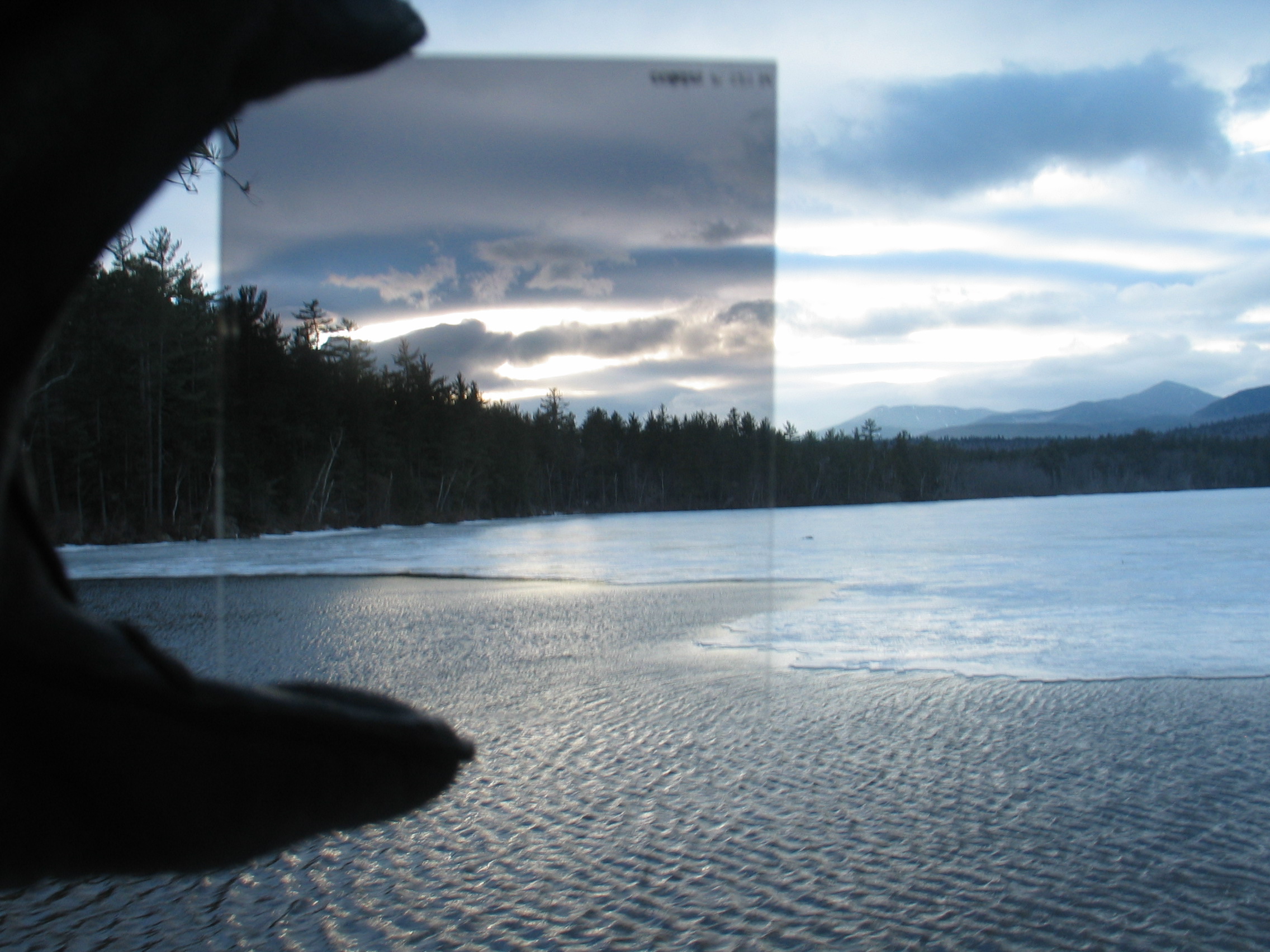


GND filter

GND or Graduated Neutral Density

A GND filter is neutral density filter with different attenuation at different points, typically dark on one side and gradually clears on the opposite side.  It is used to balance out the exposure of a scene, like when the sky is too bright compared to the ground.

These are commonly square, but there are circular GNDs too.

DSC_4603
IR Photography by Michael Ocaña


IR or Infrared Filters

IR filters capture infrared light.  These creates a dreamy, false color images.  Digital images captured by IR filters are post processed through photo editing software like Adobe's Photoshop to produce that dreamy effect.


What are square filters?

A common filter is a threaded round filter and screws on directly onto the lens.  A square filter needs to have a holder set in order to be mounted.  

A holder set consists of two accessories: a thread adapter ring and a filter holder.

The thread adapter should have the same diameter with the lens' filter thread; much like a circular filter.

The filter holder is attached by sliding it on the thread adapter.  It will lock on place and is freely rotatable.  A Cokin holder may hold 3 filters at once.

A square filter is then attached to the holder by, again, sliding it in the holder mount.  Since the holder can accommodate 3 filters,  it is up to the photographer's creativity to mix different filters to get the desired effect.

There are different sizes of square filters and it's corresponding holder.  Common sizes are 85mm (Cokin P-series) and 100mm (Cokin Z pro).

A square holder set may differ with different brands but the function is the same, to hold square filters.

Graduated Color Square Filter

These filters are like GNDs but instead of one side neutral density, it is one side color.  Common colors are graduated blue,  red, orange, green, and sunset orange.  These are used for creativity effects.

There are other types of filters but these are the common ones.  So there you have it, any more queries about lens filters?  Here are some links for you.

Photographic Filters
Cokin
Lens Filters Explained


Tuesday, August 28, 2012

Beginner's tips on photography

Starting a hobby in photography is exciting.  Of course you get to have a new toy to play with.  Discovering your passion in photography.  Exploring the wonders of capturing the moment.  I'd like to share some tips on how to improve your skills.


Read up on photography

Reading books or magazines on photography will help you understand or maybe even discover something new about the field of photography.  Though this might be expensive, but it does help improve your learning.

Photoblogs and websites

There are tons of blogs and website about photography, and your on one now. ;)  Visiting blog sites on photography will broaden your mind to new ideas and techniques.  Be sure to read the blogs and watch videos about photography.

Join online forums

When I started, I didn't have friends who were into photography.  I had a difficult time learning on my own.  I found a local online forum that had a photography forum topic.  There I found a thread about the model of camera I was using.  I joined that thread and learned a lot.  

Online forums make learning about photography easier and faster.  You can ask specific question that sometimes can't be found in search engines.  It is a means for interacting with fellow photographers online.  Try looking for local forums, someone might have an open invitation to a shoot, this way you can join.  

You can also ask for some comments and criticisms on your image.  This way you'll learn how to improve your style.  Ask for advise on the best way to improve your image.

Join in local photo walks or photo shoot

Through online forums, you may find an open invitation to join in a photo walk or a shoot.  Photo walks is a great way to practice photography.  It trains your eyes alert for possible subjects.  It keeps your mind visualizing how you would shoot the subject; how to compose the frame.

Photography workshops

If budget permits, join photo workshops.   You'll learn some tips and secrets in photography workshops; especially if the host or instructor is a famous photographer.

Shoot, shoot, and shoot

I think best way to improve your eyes and skill in photography is to shoot.  Always bring your camera with you.  If you see something that captures your attention, shoot it.  If you see a beautiful cloud formation, shoot it.  

If you keep on shooting, you'll learn how your camera works.  You'll learn how to reset the settings to different lighting conditions.  You'll learn how to look for good lighting.  You'll learn to play with light.  Just keep shooting.

Monday, August 27, 2012

New to photography: Exposure Trio

My previous post, New to photography: Gear, I talked about gears to start.  Now you buy your camera, read the manual, and tried some shots. Common questions I hear from newbies are: Why aren't my images look good? Why is it dark? or Why is it blurry? I will discuss some basics in photography namely the Exposure Trio.


What is Exposure?

Exposure is the amount of light that your sensor captures.  Photography is all about light. It is like your eyes. The eyes captures light. We see color, contrasts, brightness, darkness; in the same way the camera medium does, in this case the sensor. So basically photography is capturing light.

How to control exposure?

In photography, there are three main aspects in controlling exposure, the exposure trio. These are ISO, Shutter Speed, and Aperture.   Each of these three have their own commands in your dslr. That's why READ your manual for a smoother photography experience.


Now you might wonder what these trio actually do.  Here is a quick explanation of each.

ISO

ISO basically is the  sensitivity of your sensor to light.  The higher the ISO the more sensitive or more light can be captured.  High ISO has it's downside.  Current mid level dslr's now can go as high as ISO 25,600.  Whew!  But at a cost, noise.  To have a clean image, a low ISO is best and around ISO 3,200 the max (based on Nikon D7000 ISO performance), or even 6,400.   So be careful in adjusting your ISO.  Test your camera and find out at what max ISO can you get a clean image.

Shutter Speed

Your camera has a shutter.  It opens when you press the shutter release to expose your sensor to the light.  Shutter speed pertains to how long your sensor is exposed to the light coming in through the lens.  It is measured in seconds.  Current mid level dslr's have a shutter speed of 1/8000 sec. to 30 sec, and of course, Bulb mode for even longer exposures.

Shutter speed has a way with motion.  If you use a fast shutter speed, say 1/2000 sec., you would freeze the moving object.  But if you use a slower speed, like 2 sec., you'd see a motion blur.  For sports photographers, a fast shutter speed is required, to get that sharp and crisp action.  For landscape photographers, a slower shutter speed is need to get that creamy effect in running water or waves. 

Aperture

Aperture is the size of the opening of the lens.  It is designated with the " f ", example f/1.8.  Aperture controls the amount of light passing through the lens to the sensor.   It is also called f-stops.  

Most of those new to photography will be confused on how to describe the f-stop.  The larger the number, say f/16, is referred to as a small stop.  But a f/1.8, is the large stop.  Don't get me wrong, I myself get confused sometimes.

Aperture controls DOF or Depth of Field.  Meaning a smaller stop (around f/8 upward) will produce sharper image across the frame, while a larger stop (like f/1.8) will produce what we call a bokeh or blur to the background or foreground of a subject.  Landscape shooters and studio shooters shoots at smaller stops to get the detail of the entire frame while an outdoor portrait shooter shoots at larger stops to get the bokeh effect.


Whew! a lot to sink in.  If you've noticed all three controls the light that passes through the camera.  Think of it as this:

ISO - how sensitive to light
Shutter Speed - how long the light passes through
Aperture - how large the passage of light

Mixing the amount of each is an art of light.  It is like your playing with light using your camera.

Keep on shooting.

Sunday, August 26, 2012

New to Photography: Gear

A few of my friends who want to start a hobby in photography asks me; What brand of camera should they buy?  Common brands are (of course) Nikon or Canon.  Another question I encountered is: What lens do I start with?

Here are my recommendations for you guys who want to try photography:


Camera Brand

Nikon or Canon?  Either brand will do, heck you can go for Sony or Olympus, just as long as you enjoy your craft.  

Go with the brand which most of your friends, with dslr's, are using.  In that way, if you have questions on the operation of the gear, you can ask your friends how.  

If your friends aren't into photography but you are, then go to a photography store and try out the cameras.  Choose which one feels right.

I would recommend a middle level cameras.  You know those cameras with a top lcd, like Nikon's D7000 or Canon's 60D, if your budget permits.  These cameras give you much control of your shooting style.  But if you're in a budget, then go with the entry level dslr's.  

Lens

Start off with the kit lens, like 18-55mm or 18-105mm.  These are good lenses.  Learn the ways of the art and look for your genre.  If you've found the genre of photography you want, then go and buy lenses specifically for the genre.  For instance, you find yourself loving landscapes, like I do, then go look for an UWA (Ultra-wide lens) like Sigma's 10-20mm.

I'd recommend that you at least have a prime lens, a 50mm.  Whether or not you're into portraits, having a prime lens is a must.  I'm sure you'll want to try those lovely bokeh, blurry backgrounds, usually in portraits.   You'll never know when you might need it.

Manual

Read the manual!!  Study the camera, know the in's and out's of your new toy.  Once you've learned the commands, capturing image would be a smooth operation.

Camera Bags

Bags are important.  Find a bag that suits your needs.  First find a bag that is simple and ambiguously looks like a normal bag, for safety.  There are bags that at first glance you'd know it's a camera bag.


These are the basic gears to start your journey to photography.  There are more "genre-specific" gears like tripod, flashguns, light stands, etc.  Get these only when you've found your true genre.  

So go out and shoot, shoot, shoot.